Successful Participation in the “Youth in a Digital Society” Conference
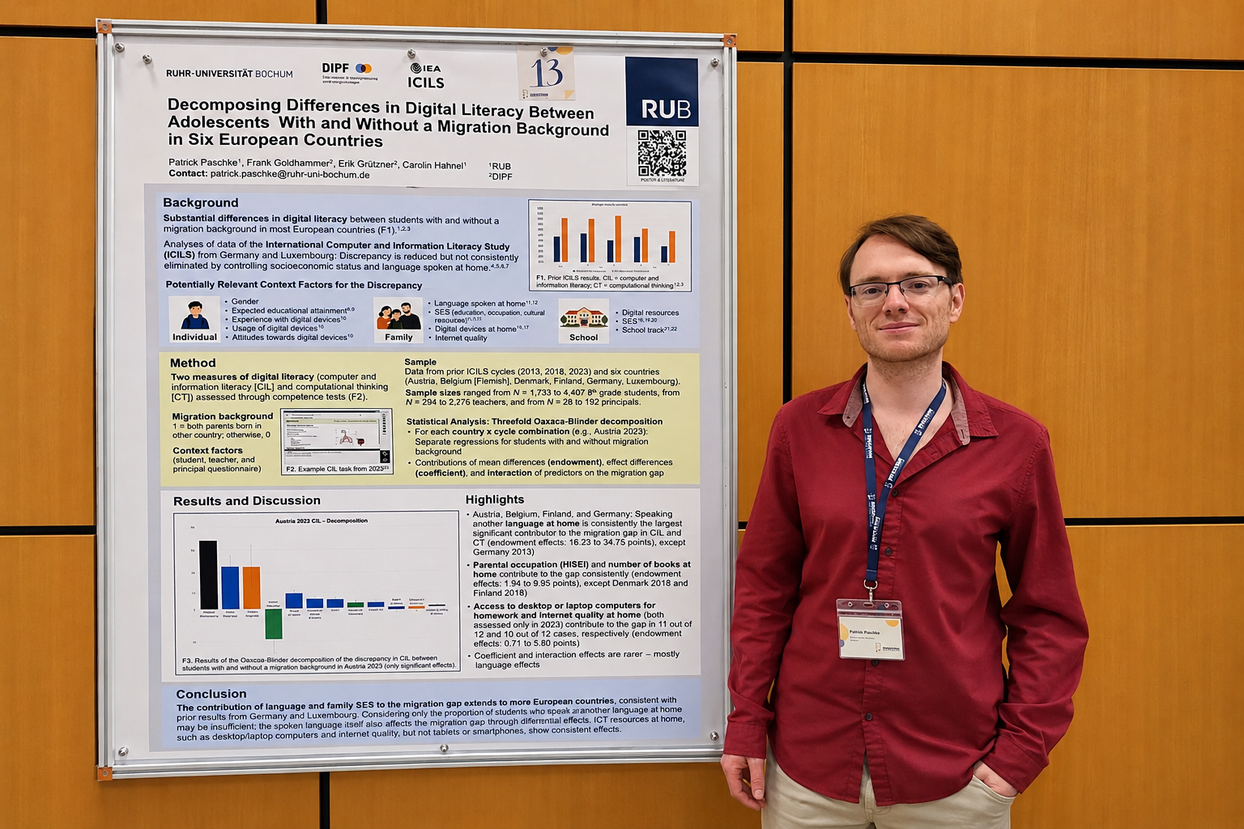
On October 7 and 8, Dr. Patrick Paschke and Erik Grützner attended the “Youth in a Digital Society” conference (Conference “Youth in a Digital Society” - Events - Research Focus: Education for the Future - University of Potsdam) at the University of Potsdam, where they presented their research:
Patrick Paschke and colleagues from the research group: “Decomposing Differences in Digital Literacy Between Adolescent Students With and Without a Migration Background in Six European Countries”
All three previous ICILS cycles—2013, 2018, and 2023—have shown that, on average, students with a migration background score lower on digital literacy than students without a migration background. In our study, we were able to show that these migration-related differences are linked to differences in the students’ home environments. The most significant factors identified were the language spoken at home, parents’ occupations, cultural resources in the home, as well as access to computers and the quality of internet access at home. Our findings thus suggest that migration-related differences in digital competencies can also be explained by the fact that students with a migration background do not have the same resources available at home as their peers without a migration background.
Erik Grützner and colleagues from the research group: Schools as Contexts of Equitable Digital Participation: A Trend-Based ICILS Perspective on Germany
Various studies from the 2013, 2018, and 2023 ICILS cycles have used the term “resilient schools,” which is defined as schools whose students demonstrate above-average digital competencies even though they come from families with below-average incomes.
However, this approach does not take into account other aspects of social disadvantage, such as migration background, the language spoken at home, and cultural resources. In our study, we investigated whether a group of resilient schools can be identified in Germany whose characteristics regarding social disadvantage and digital competencies remain stable across the three ICILS cycles, and how these schools differ from others in terms of teaching and learning processes. Our results did not reveal a distinct group of resilient schools, but rather a three-class classification that remained stable across the cycles: socially disadvantaged schools with low digital competencies, intermediate schools (moderate in both areas), and socially privileged schools (high in both areas). These school types do not differ in the teaching and learning processes examined, but they do differ in students’ digital self-efficacy expectations; in this regard, socially privileged schools perform better than schools in the other two groups. The results thus suggest that school resilience is an individual and school-specific process.
We would like to thank the organizing team of “Youth in a Digital Society” at the University of Potsdam for organizing this wonderful conference. Participating in the conference allowed us to gain new academic insights and exchange ideas with other researchers in the field of digital education!